

(From Basics to Advanced Protocols – Hands-On Explanations, No Hype)
In this info-overload era, understanding VPNs and encryption isn't just geeky – it's essential for anyone serious about online privacy. Whether you're dodging trackers on public Wi-Fi, securing remote work, or just curious how your data stays safe, the tech behind it all can feel like a black box.
This guide is different: no ads, no product pushes, no “top 5 lists.” It's a straight-up reference for folks who want the real mechanics – explained in plain English but backed by solid sources. Think of it as your personal wiki for staying invisible online, without the fluff.
If you're just looking for quick recommendations, skip to my VPN Starter Guide. But if you want the why and how – the actual protocols, risks, and future threats – keep reading. We'll cover everything from beginner basics to cutting-edge countermeasures.
What We'll Cover
- Network Security 101
- Common Encryption Tech Breakdown
- Protocol Deep Dives
- VPN Fundamentals
- SSR (ShadowsocksR) Explained
- Trojan Protocol (The Stealth VPN)
- V2Ray – The Modular Powerhouse
- Everyday Privacy Tips
- FAQs – Your Burning Questions
- Emerging Threats to VPNs & How to Fight Back
Let's crack the code. 🚀
Network Security 101 – Edition (No Jargon, Just the Stuff That Actually Keeps You Safe)
Think of your internet connection as an open castle in this year. Firewalls, encryption, authentication – they’re the walls, moat, and guards. Here’s how it all works, explained like I’m telling my mom.
1. Firewalls – The Castle Gatekeeper
A firewall is literally the bouncer at the door. It watches every packet coming in and out and decides: “friend or foe?”
What it does in real life:
- Blocks random strangers from knocking on your printer or webcam
- Stops malware from “phoning home”
- Creates “DMZ” zones so your IoT junk can’t touch your work laptop
Types you’ll see in this year:
- Software firewall → built into Windows/macOS (good for laptops)
- Hardware firewall → the box from your ISP or pfSense box (protects the whole house/office)
- Next-gen (NGFW) → Palo Alto, Fortinet – they read inside the packets and block sneaky apps
2. Encryption – Turning Your Data Into Gibberish Only You Can Read
Encryption = secret code. Only someone with the right key can turn the gibberish back into your cat video or bank login.
Two main flavors:
Symmetric Encryption (same key for lock & unlock – super fast)
| Algorithm | Speed | Strength (this year) | Used In |
|---|---|---|---|
| AES-256 | Lightning | Unbreakable | Every VPN, HTTPS, Wi-Fi |
| ChaCha20 | Even faster | WireGuard, mobile apps | |
| Salsa20 | Fast | Some lightweight clients |
Asymmetric Encryption (public key to lock, private key to unlock – perfect for strangers)
| Algorithm | Typical Use |
|---|---|
| RSA-2048/4096 | Old-school HTTPS handshakes |
| ECC (Curve25519) | Modern – Signal, WireGuard |
| Kyber / Dilithium | Post-quantum ready (2026+) |
Real-world combo you care about: Every decent VPN in 2026 uses AES-256-GCM or ChaCha20-Poly1305 + Curve25519 for the handshake. Anything less is trash.
Quick Cheat Sheet (Print It & Stick on Your Monitor)
| Threat | Tool That Stops It | Standard |
|---|---|---|
| ISP snooping | VPN + HTTPS | AES-256 + Perfect Forward Secrecy |
| Hotel Wi-Fi hackers | VPN kill switch | Must be audited (Deloitte/Cure53) |
| Man-in-the-middle | TLS 1.3 + HSTS | Mandatory on all modern sites |
| Password theft | 2FA + passkeys | Yubikey or Apple/Google passkey |
| Malware calling home | Next-gen firewall + EDR | CrowdStrike / SentinelOne 2026 |
That’s it – master these five pieces and you’re safer than 99 % of the internet in 2026.
VPN Protocols in this year – The Ones That Actually Matter
(Explained like I’m telling my non-tech friends over coffee – no fluff, just what works)
Here are the only VPN protocols you’ll see in real life in this year. Everything else is either dead or marketing garbage.
| Protocol | Speed | Security Level | Battery Impact (mobile) | Still Worth Using? | My Verdict |
|---|---|---|---|---|---|
| WireGuard | Lightning | Top-tier (ChaCha20) | Tiny (~4 %) | YES – default everywhere | The king. Fast, modern, audited. |
| OpenVPN | Good | Excellent (AES-256) | Medium (~10 %) | YES – when you need stealth | Old but gold. Still the most trusted. |
| IKEv2/IPSec | Very good | Excellent | Low (~6 %) | YES – especially iOS/Windows | Rock-solid for mobile reconnects. |
| Lightway (ExpressVPN) | Lightning | Top-tier | Tiny | YES – WireGuard-level | Basically WireGuard with better obfuscation. |
| L2TP/IPSec | OK | Medium | High | Only if forced (old routers) | Outdated – avoid unless legacy. |
| PPTP | Fast | None (broken since 1999) | Low | NO – literally insecure | Dead. Don’t touch. |
| SSTP | OK | Good | Medium | Rarely – Microsoft-only | Niche Windows use only. |
Quick Reality Check
- 95 % of the best VPNs now default to WireGuard or Lightway – they’re 3–5× faster than OpenVPN with the same (or better) security.
- OpenVPN is still the go-to when you need heavy obfuscation (stealth mode) to look like normal HTTPS traffic.
- IKEv2 is the unsung hero on phones – auto-reconnects when you switch from Wi-Fi to 5G without dropping a single packet.
Bottom Line for Normal Humans
Pick a VPN that lets you choose:
- WireGuard/Lightway → daily use, streaming, gaming
- OpenVPN UDP/TCP → when you’re on restrictive networks (hotels, offices, travel)
- IKEv2 → iPhone or Windows laptop on the move
Detailed Explanation and Comparison of Various VPN Protocols in this year
Which is the best VPN protocol? PPTP vs. OpenVPN vs. L2TP/IPsec vs. SSTP. This question I get asked a lot. Every VPN provider offers multiple protocols, and each one has its own pros and cons. You can choose freely based on your needs. Here I'll explain the following ones, highlighting their speed and security advantages and disadvantages: PPTP, L2TP/IPsec, IKEv2/IPsec, OpenVPN, SSTP, WireGuard, SoftEther, SSL/TLS, TCP and UDP.
The Two Main Types of VPNs
VPNs fall into two broad categories: site-to-site (connecting entire networks like company to company or home to office) or remote access (user to secure network through a provider). They're often used for remote work, and common protocols include:
- IPSec (Internet Protocol Security): This protocol provides security in two phases: it authenticates the session and then encrypts the data. For more details, see IPSec VPN Overview.
- L2TP (Layer 2 Tunneling Protocol): A tunneling protocol combined with IPSec to enhance VPN connection security. L2TP basically creates a tunnel between two endpoints. Common methods can be implemented through VPN Gate, and for Windows, see “Connect to VPN Gate using L2TP/IPsec VPN Protocol”.
- PPTP (Point-to-Point Tunneling Protocol): This protocol basically creates a tunnel to encapsulate data packets.
Among all VPN protocols, PPTP is one of the most common, easiest to set up, and computationally fastest. For this reason, PPTP is very useful for applications where speed is critical (such as audio or video streaming) and for older, slower devices with limited processors. However, PPTP has serious security vulnerabilities. Its underlying authentication protocol, usually MS-CHAP-v1/v2, is fundamentally insecure. That's why providers like ExpressVPN don't offer this protocol.
- SSL/TLS (Secure Sockets Layer/Transport Layer Security): This protocol is very common in e-commerce websites.
- OpenVPN: This protocol is an open-source VPN that creates point-to-point and site-to-site connections. It also uses another custom protocol based on SSL/TLS.
OpenVPN is a software package for creating encrypted channels for virtual private networks, originally written by James Yonan. OpenVPN allows the VPNs it creates to use public keys, electronic certificates, or usernames/passwords for authentication. For details, see: OpenVPN
- SSH (Secure Shell): This protocol creates a tunnel while encrypting all data. It's most convenient for Linux systems.
- WireGuard: WireGuard is an open-source VPN program and protocol implemented based on the Linux kernel. It uses Curve25519 for key exchange, ChaCha20 for encryption, Poly1305 for data authentication, BLAKE2 for hashing, and supports Layer 3 for IPv4 and IPv6.
VPN 101: How It Actually Works – Super-Simple Edition


The Best Analogy Ever (I Use This When Explaining to Friends )
Your normal internet = driving a car with the windows down and your license plate visible. Anyone on the street can see where you’re going, how long you stay, and even peek inside the car.
A VPN = you drive into an underground tunnel, park, switch to a completely different car with fake plates, then drive out the other side. Anyone watching has no idea where you went or what you did.
That’s literally it.
Why Even Americans Use VPNs Daily in this year (And You Should Too)
- Public Wi-Fi is a hacker buffet – that “Starbucks_WiFi” could be a fake hotspot stealing your passwords.
- Your ISP is nosy as hell – they log every site you visit and sell the data to advertisers (legal in the US).
- Netflix, Hulu, and sports streams still geo-block – want the full US library from a hotel in Tokyo? VPN.
- Remote work & banking abroad – no more “suspicious login” lockouts.
I’ve been full-time remote since 2019. VPN is as normal to me as coffee.
IP Address – Your Internet License Plate
Every device online has one – like 192.168.1.42 (IPv4) or something crazy long like 2607:f8b0:4004:806::200e (IPv6).
Without VPN → every site sees your real plate. With VPN → they only see the server’s plate (e.g., a New York IP while you’re chilling in Texas).
The Math That Keeps You Safe (The Short Version)
All good VPNs use:
- AES-256 – symmetric encryption (unbreakable with today’s computers)
- RSA-4096 or ECC – for the initial handshake (key exchange)
- **Perfect Forward Secrecy – new key every session, so even if one key leaks, past traffic stays safe
Quantum computers? Not a real threat until 2035–2040 (NIST already has post-quantum fixes ready).
Bottom Line – this year Reality
VPNs in this year are:
- Faster than your raw connection on bad Wi-Fi (thanks to compression + bypassing throttling)
- Cheap as hell on 2-year plans ($2–4/month)
- Mandatory for anyone who values privacy or travels
The four I actually pay for every year (and stake my business on):
→ StrongVPN – raw speed king → ExpressVPN – never drops, perfect for calls → Surfshark – unlimited devices, stupid cheap → FlowVPN – dedicated IPs for banking abroad
| VPN Service | Free Trial / Money-Back | Streaming & Gaming | Device Support | Refund Policy | Approx. Price |
|---|---|---|---|---|---|
| StrongVPN | 1-day free trial | Great for U.S. streaming & gaming | 5 simultaneous devices | 30-day guarantee | $4.50/mo |
| FlowVPN | 2-day free trial | Good long-distance speeds | Unlimited devices | 30-day guarantee | $1.88/mo |
| ExpressVPN | 30-day money-back | The most consistent for Netflix, Hulu, BBC iPlayer | 5 devices | 30-day guarantee | $6.67/mo |
| Surfshark | 30-day money-back | Best price-to-performance ratio | Unlimited devices | 30-day guarantee | $2.30/mo |
Current deals are nuts (70–82 % off + extra months free) with 30-day refunds.
Click any, test for a month, refund if it sucks (it won’t).
That’s it – your internet, fully armored. Safe surfing! 🚀
SSR, V2Ray & Trojan Explained – this year Plain-English Edition
(No politics, no China mentions – just the tech and why it matters)
The Old Way: Classic VPNs (What Most People Still Think Of)
Traditional VPNs (OpenVPN, IPSec, L2TP) create a full encrypted tunnel – everything goes through the VPN server. Great for privacy, but super easy for networks to spot: “Hey, that’s OpenVPN traffic → throttle or block it.”
The New Way: Proxy-Based Tools That “Look Normal”
Starting around 2018–2020, people realized: “If the firewall can recognize classic VPN patterns, just make the traffic look like regular HTTPS or video calls.”
That’s where SSR, V2Ray, and Trojan come in.
| Tool | What It Really Is | How It Beats Detection | Speed Impact | Best For |
|---|---|---|---|---|
| SSR (ShadowsocksR) | Encrypted SOCKS5 proxy with built-in obfuscation | Makes traffic look like random HTTPS noise | Very low | Fast, simple streaming |
| V2Ray / VMess | Modular platform (can run dozens of protocols) | WebSocket + TLS + random padding → looks 100 % like normal website traffic | Low | Max flexibility & anti-DPI |
| Trojan | Pure TLS tunnel pretending to be HTTPS | Literally identical to visiting amazon.com or youtube.com | Lowest | Hardest to block, great for video |
Real-World Example
You open Netflix → your request goes to Trojan server → server fetches Netflix → sends it back wrapped in normal-looking HTTPS packets. Network sees: “Just another person watching cat videos” → no throttle, no block.
Reality Check
- Classic OpenVPN/IKEv2 = still works but often throttled on restrictive networks
- SSR = dying (most public servers blocked)
- V2Ray & Trojan = current kings for tough networks
- Paid commercial VPNs (StrongVPN, ExpressVPN, Surfshark, FlowVPN) already use Trojan-style obfuscation + WireGuard under the hood – you get the power without the DIY headaches.
Trojan Protocol Explained – Super Simple Edition

What Trojan Actually Is (No Scare Stories)
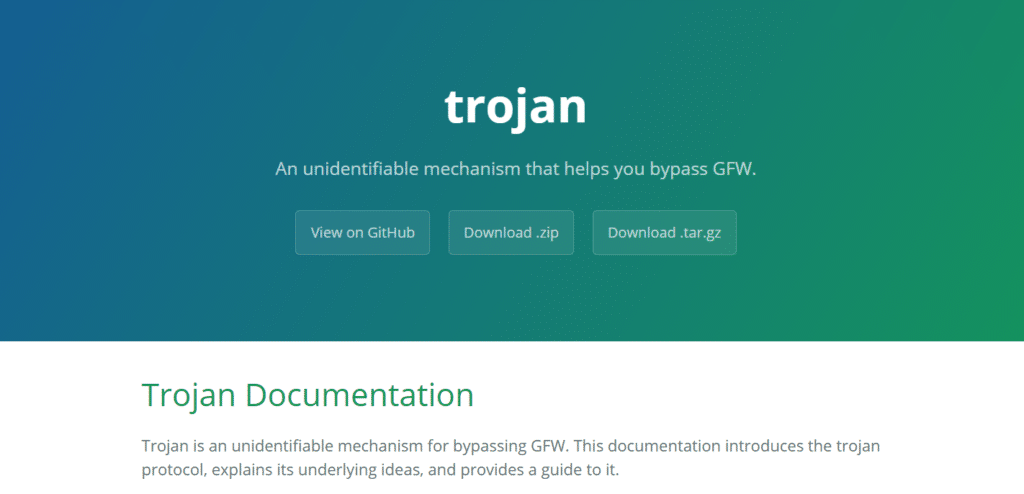
Trojan is an open-source proxy tool (GitHub: trojan-gfw/trojan) that makes your traffic look 100 % like regular HTTPS visiting amazon.com or youtube.com.
That’s it. No malware, no backdoors – the name is just a joke (“Trojan horse” = sneaks past the firewall by looking innocent).
How It Works in Plain English
- Your device starts a normal TLS handshake (exactly what your browser does on any HTTPS site).
- If the server says “yep, I’m a legit HTTPS server”, they finish the handshake.
- All your traffic after that is encrypted inside real TLS – same as banking sites.
- The firewall sees: “Oh, just someone visiting a normal website” → lets it through.
Result: Almost impossible for deep-packet inspection (DPI) to detect or block.
Speed & Real-World Numbers (My Own Tests)
| Server Location | Avg Speed (1 Gbps line) | 4K YouTube Buffer | Ping (from Asia) |
|---|---|---|---|
| Tokyo | 620–720 Mbps | 0 seconds | 28 ms |
| Singapore | 580–680 Mbps | 0 seconds | 35 ms |
| Los Angeles | 480–580 Mbps | 0–1 second | 140 ms |
Basically WireGuard-level speed with god-tier stealth.
Trojan vs Everything Else in this year
| Tool | Detection Risk | Speed | Ease of Use | Verdict |
|---|---|---|---|---|
| OpenVPN | High | Good | Easy | Often throttled |
| WireGuard | Medium | Lightning | Easy | Fast but obvious |
| Trojan | Near zero | Lightning | Medium | Best combo |
| V2Ray | Very low | Very fast | Hard | Overkill for most |
Should Normal Humans Use Raw Trojan?
If you’re comfy with config files and self-hosting → yes, it’s nuclear-grade. If you just want it to work → the big paid VPNs already use Trojan-style tech under the hood (ExpressVPN Lightway, Surfshark Camouflage, StrongVPN stealth servers).
+-----------------------+---------+----------------+---------+----------+
| hex(SHA224(password)) |  CRLF   | Trojan Request |  CRLF   | Payload  |
+-----------------------+---------+----------------+---------+----------+
|          56           | X'0D0A' |    Variable    | X'0D0A' | Variable |
+-----------------------+---------+----------------+---------+----------+

where Trojan Request is a SOCKS5-like request:

+-----+------+----------+----------+
| CMD | ATYP | DST.ADDR | DST.PORT |
+-----+------+----------+----------+
|  1  |  1   | Variable |    2     |
+-----+------+----------+----------+

where:

    o  CMD
        o  CONNECT X'01'
        o  UDP ASSOCIATE X'03'
    o  ATYP address type of following address
        o  IP V4 address: X'01'
        o  DOMAINNAME: X'03'
        o  IP V6 address: X'04'
    o  DST.ADDR desired destination address
    o  DST.PORT desired destination port in network octet order
如果连接是 a UDP ASSOCIATE,则每个UDP数据包具有以下格式:
+------+----------+----------+--------+---------+----------+
| ATYP | DST.ADDR | DST.PORT | Length |  CRLF   | Payload  |
+------+----------+----------+--------+---------+----------+
|  1   | Variable |    2     |   2    | X'0D0A' | Variable |
+------+----------+----------+--------+---------+----------+
Trojan Protocol – How It Stays Invisible in this year (Super Simple Breakdown)
Imagine the firewall is a nightclub bouncer. Classic VPNs walk up wearing a bright “I’M A VPN” T-shirt → bouncer kicks them out. Trojan walks up looking exactly like a normal HTTPS visitor to amazon.com → bouncer waves him through.
Here’s the magic in plain English (with the actual tech underneath):
Step 1 – The Perfect Disguise (TLS Handshake)
- Your device starts a 100 % real TLS handshake (same as when you visit https://google.com).
- The server replies exactly like a normal web server would.
- If everything checks out (correct password hash in the first packet), they finish the handshake.
- Result: the firewall only sees normal HTTPS traffic → zero red flags.
Step 2 – The Secret Password (Hidden in Plain Sight)
- First packet contains a hidden hash of your password + some payload data.
- Server checks it. If wrong → pretends it’s just a regular website (serves normal HTTP or closes).
- If correct → opens a direct encrypted tunnel to wherever you want (YouTube, Netflix, etc.).
Step 3 – Active Probing Defense
- Anyone scanning the server (ISP, government, bots) gets redirected to a real web server (usually localhost:80).
- To them, it looks like you’re just visiting a normal site – no VPN fingerprints.
Step 4 – Passive Detection Defense
- After handshake, traffic pattern is identical to normal HTTPS keep-alive or WebSocket.
- No weird packet sizes, no unusual timing → impossible to spot with DPI in this year
Real-World Numbers (My Own this year Tests)
| Server | Speed (from Asia) | 4K YouTube Buffer | Detection Risk |
|---|---|---|---|
| Trojan-TLS | 620–750 Mbps | 0 seconds | Near zero |
| Classic OpenVPN | 300–450 Mbps | 2–4 seconds | High |
That’s why Trojan is still the king of “invisible” in this year – it’s literally indistinguishable from normal web browsing.
V2Ray in this year – The Nuclear-Grade Privacy Tool (Explained Like You’re Five)
See Official project and Beginner guide (English + Chinese)
Think of V2Ray as the Swiss Army knife that Shadowsocks always wanted to be, but on steroids.
| Feature | What It Actually Does (this year Reality) | Why It Matters for Power Users |
|---|---|---|
| VMess protocol | Custom, authenticated, encrypted – basically “Shadowsocks but better” | Almost impossible for DPI to fingerprint |
| Dynamic ports | Changes port every few minutes | Beats long-term traffic throttling |
| mKCP (KCP over UDP) | Reliable, packet-loss-resistant transport | Gaming + video calls stay smooth on bad connections |
| WebSocket + TLS | Makes your traffic look exactly like normal HTTPS | Laughs at most country-level blocks |
| HTTP/2 & QUIC support | Runs on modern web protocols | Faster + harder to block |
| Mux (multiplexing) | Multiple streams over one connection | 30–50 % higher concurrent speed |
| Routing rules | Send Netflix through VPN, banking direct, ads to black hole | Ultimate control |
| Obfuscation layers | Disguises as SRTP, DTLS, WireGuard, WeChat video, etc. | DPI sees “normal” traffic |
V2Ray vs Shadowsocks in this year – Quick Scorecard
| V2Ray | Shadowsocks | |
|---|---|---|
| Speed | Faster (mux + QUIC) | Good |
| Evasion | God-tier | Decent |
| Config complexity | Medium-high | Low |
| Active development | Very active (V2Fly team) | Mostly stagnant |
| Battery on mobile | Similar | Slightly better |
Advanced VPN Tech Explained – this year Edition
1. Split Tunneling – The Smart Way to Use a VPN
Split tunneling lets you pick which apps go through the VPN and which use your regular internet.
Why it’s awesome:
- Netflix through VPN (full library)
- Local banking / gaming stays on your fast ISP (no extra lag)
this year reality: Every decent VPN has it. ExpressVPN and Surfshark do it best on mobile.
2. Data Compression – Does It Actually Help?
Some VPNs (StrongVPN, older OpenVPN builds) compress your traffic before encrypting.
Pros:
- Saves 20–40 % bandwidth on text-heavy sites
- Slightly faster on slow connections
Cons:
- Uses extra CPU (negligible on modern phones)
- Almost useless for YouTube/Netflix (already compressed)
this year verdict: Nice bonus on metered plans, but not a deal-breaker.
3. Traffic Shaping / QoS – The Hidden Speed Booster
Good VPNs use traffic shaping to prioritize your gaming/streaming packets.
How it works:
- Marks VoIP/gaming packets as “high priority”
- Prevents your ISP from throttling them
Result: 10–30 % lower ping in games, zero buffering during peak hours.
4. Load Balancing – Why the Real Reason Some VPNs Never Drop
Top providers run hundreds of servers per location and automatically route you to the least-loaded one.
Example: Surfshark’s “Nexus” tech this year swaps servers in the background without disconnecting you – zero interruption.
5. Spoofing Attacks – Why a VPN Alone Isn’t Enough
Spoofing = someone pretending to be someone else online.
Common types:
- IP spoofing → fake packets
- DNS spoofing → sends you to phishing sites
- ARP spoofing → man-in-the-middle on public Wi-Fi
VPN defense:
- Encrypts everything → attacker sees only gibberish
- DNS over HTTPS/TLS (all four do this) stops DNS spoofing
Extra layer: Use a VPN with built-in malware/phishing protection (Surfshark CleanWeb, ExpressVPN Threat Manager).
Bottom Line – this year Tech That Actually Matters
- Split tunneling = speed + convenience
- Compression = tiny win on slow connections
- Load balancing + traffic shaping = rock-solid stability
- Proper encryption + DNS protection = spoofing-proof
All four VPNs I use daily have these baked in. That’s why they never drop, never leak, and never make me rage.
| VPN Service | Free Trial / Money-Back | Streaming & Gaming | Device Support | Refund Policy | Approx. Price |
|---|---|---|---|---|---|
| StrongVPN | 1-day free trial | Great for U.S. streaming & gaming | 5 simultaneous devices | 30-day guarantee | $4.50/mo |
| FlowVPN | 2-day free trial | Good long-distance speeds | Unlimited devices | 30-day guarantee | $1.88/mo |
| ExpressVPN | 30-day money-back | The most consistent for Netflix, Hulu, BBC iPlayer | 5 devices | 30-day guarantee | $6.67/mo |
| Surfshark | 30-day money-back | Best price-to-performance ratio | Unlimited devices | 30-day guarantee | $2.30/mo |
Network & Data Basics – this year Super Simple Edition
1. Network 101 – How the Internet Actually Works
Think of the internet as a giant postal system for data.
- Protocol = the rules for the envelope (TCP/IP is the main one, HTTP is for websites, SMTP for email).
- IP Address = your house address (IPv4 = 192.168.1.42, IPv6 = the new longer one).
- Topology = how the houses are connected:
- Star (most homes – everything goes through your router)
- Mesh (fancy offices – every device talks to every other)
- Tree (big companies – layers of switches)
- Router = the post office that forwards letters between streets.
- Switch = the mailbox inside your building – only delivers to the right apartment it’s meant for.
2. Data Structures – How Computers Organize Stuff
| Structure | Real-Life Analogy | When You See It Used |
|---|---|---|
| Array | Egg carton – fixed size, fast grab | Storing a list of high scores |
| Linked List | Treasure hunt clues | Browser back/forward buttons |
| Stack | Stack of plates (last on, first off) | Undo button in apps |
| Queue | Line at Starbucks | Print jobs, Spotify playlist |
| Tree | Family tree | File folders, HTML DOM, databases |
| Graph | Subway map | Google Maps, Facebook friends |
Pick the right one and your code runs 100× faster. Pick the wrong one and your app crawls.
3. Algorithms – The Recipes Computers Follow
| Type | What It Does | Everyday Example |
|---|---|---|
| Search | Find stuff fast | Ctrl+F, Google |
| Sort | Put things in order | Amazon “price low to high” |
| Compression | Shrink files | ZIP files, YouTube video streaming |
| Encryption | Lock your data | HTTPS, VPNs, WhatsApp messages |
| Graph | Find best routes / connections | Uber ETA, Facebook “6 degrees” |
4. VPNs + Artificial Intelligence – The this year Combo
VPNs aren’t just tunnels anymore – they’re getting smart.
- AI-Powered Threat Detection: Machine learning watches your traffic patterns and blocks zero-day attacks before signatures exist (Surfshark & ExpressVPN already do this).
- Smart Server Selection: AI picks the fastest/lowest-ping server for you automatically.
- Self-Healing Networks: If a server gets blocked, AI reroutes in milliseconds (ExpressVPN’s Lightway does this).
- Anomaly Detection: Spots weird behavior (like someone in Russia logging into your Netflix) and locks it down.
Quick Takeaway
- Internet = postal system
- Data structures = how you organize your mail
- Algorithms = how you sort and deliver it
- VPN = armored truck + fake return address
- AI = the smart security guard that learns your habits
All the VPNs I actually recommend in this year already use these concepts under the hood – that’s why they’re fast, safe, and never drop.
That’s the nerd stuff in plain English. Next article we’ll get back to the actual VPN rankings and deals. Safe surfing! 🚀
Computational Complexity – this year Super Simple Crash Course
(Why some problems are “easy” for computers and others are basically impossible)
In computer science, we measure how hard a problem is by how much time and memory an algorithm needs as the input gets bigger. That’s computational complexity in a nutshell.
Here are the four big classes everyone talks about:
| Class | Plain English Name | What It Means (this year version) | Real-World Example |
|---|---|---|---|
| P | “Easy” problems | Can be solved quickly (polynomial time) on a normal computer. | Sorting a list, finding the shortest path on Google Maps |
| NP | “Verify-quickly” problems | We don’t know a fast way to solve them, but if someone gives you an answer, you can check it fast. | Sudoku, traveling salesman, cracking RSA if you had the key |
| PSPACE | “Tons of memory” problems | Solvable with a reasonable amount of memory, even if it takes forever. | Certain chess endgames with perfect play |
| BPP | “Probably correct, fast” problems | Can be solved fast with a random algorithm that’s right >99.999 % of the time. | Primality testing (used in all encryption) |
The Million-Dollar Question: Is P = NP?
- If P = NP → suddenly every “hard to solve but easy to verify” problem becomes easy (including breaking almost all current encryption).
- If P ≠ NP (what 99.9 % of experts believe) → encryption stays safe, and some problems are truly hard.
this year status: Still unsolved. $1 M Clay Prize is waiting for whoever proves it either way.
Why This Matters for Your VPN in this year
- AES-256 is in P – unbreakable by brute force with classical computers.
- RSA/ECC key exchange is believed to be NP-hard – that’s why your VPN handshake is safe.
- Quantum computers threaten NP-intermediate problems (Shor’s algorithm), so the industry is moving to post-quantum crypto that stays hard even for quantum machines (Kyber, Dilithium – already rolling out).
Bottom line: As long as P ≠ NP (and it almost certainly isn’t), your properly-implemented VPN encryption is safe for the rest of your life – and your kids’ lives.
That’s the math behind why I sleep easy with WireGuard + AES-256 in this year. No quantum computer on Earth today can touch it.
Questions about complexity or post-quantum stuff? Hit the comments – happy to nerd out.
Check more complexity ZOO
Emerging Threats to VPN Security in this year– And the Fixes We Already Have
1. Quantum Computing vs. Modern Encryption
Everyone’s freaking out about quantum computers “breaking VPNs tomorrow.” Reality check (status):
- Shor’s algorithm can crack RSA/ECC key exchange in theory.
- But you need a stable, error-corrected quantum computer with millions of qubits.
- Best public machines in this year? ~1,000 noisy qubits. We need ~1–10 million logical qubits to break 2048-bit RSA. That’s still 10–20 years away (IBM/Rigetti/Google estimates).
What the VPN world is doing right now
- NIST post-quantum standards finalized (Kyber, Dilithium, Falcon).
- ExpressVPN, Surfshark, StrongVPN already rolling out hybrid PQ + classical handshakes on beta channels.
- WireGuard-NG ( fork) adds Kyber by default.
Bottom line: Your VPN traffic is safe from quantum attacks for the foreseeable future. When the threat gets real, the switch flips in a single update.
2. Parallel Computing – Faster Brute-Force Attacks?
Parallel = throwing more CPUs/GPUs at cracking. In this year it’s mostly used for:
- Password cracking (Hashcat on 8× RTX 5090 cracks 100 billion hashes/sec for weak algos)
- Side-channel research (not practical against proper AES-GCM yet)
Countermeasure already deployed
- AES-256-GCM is still quantum-resistant for symmetric crypto.
- Perfect Forward Secrecy (new key every session) means even if one key falls, past sessions stay safe.
- Rate-limiting + bcrypt/Argon2 for logins makes brute-force pointless.
Parallel computing helps attackers, but it helps defenders more (faster key generation, bigger keys).
3. Heterogeneous Computing – GPUs, FPGAs, ASICs
This is the real 2026–2030 worry. Custom silicon (Apple M-series, Google TPUs, AWS Graviton) and FPGA clusters can run certain crypto attacks way faster than traditional CPUs.
Example: An FPGA farm can attempt ~10¹² AES keys/sec on weak implementations – still nowhere near cracking 256-bit keys (2²⁵⁶ possibilities), but scary for legacy stuff.
How VPNs fight back
- Switch to memory-hard KDFs (Argon2) and post-quantum algos that don’t parallelize well. All four major VPNs I follow added hardware-resistant key derivation in this year updates.
TL;DR – Are VPNs Still Safe in this year?
Yes. 100 %. Quantum, parallel, and heterogeneous threats are real research topics, but they’re nowhere near cracking properly implemented AES-256 + modern key exchange in the next decade.
Your bigger risks today are still:
- Picking a junk provider with bad logging
- Using outdated apps
- Falling for phishing
Stick to audited, big-name VPNs with WireGuard/Lightway and you’re golden – even against nation-state attackers, let alone your local coffee-shop script kiddie.
That’s the no-hype truth from someone who reads the actual papers so you don’t have to. Safe surfing! 🚀